
 pdf
pdf
Published
2026-06-24
Issue
Section
From the Field
License
Copyright (c) 2025 CAPITULUM: The International Compositae Alliance Newsletter

This work is licensed under a Creative Commons Attribution-NonCommercial 4.0 International License.
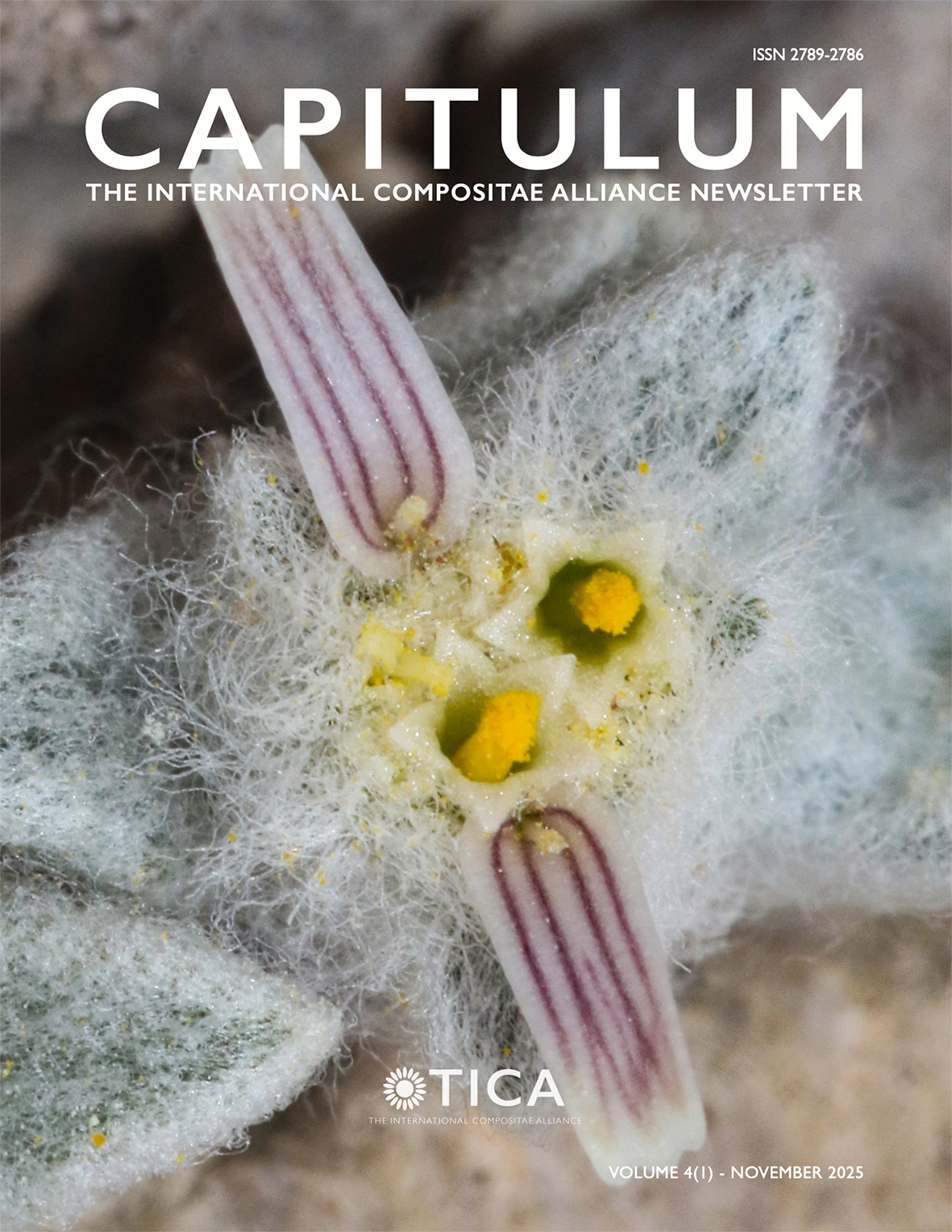
Hecastocleis shockleyi (Hecastocleideae), the desert enigma: close encounters with one of Compositae's most solitary lineages
Colin Hoag
https://orcid.org/0000-0003-3666-4266
DOI: https://doi.org/10.53875/capitulum.04.1.03
Keywords: Asteraceae, biogeography, dispersal, Great Basin, Mojave, natural history, phenology, pollination
Abstract
The desert subshrub Hecastocleis shockleyi is the sole member of tribe Hecastocleideae and sub-family
Hecastocleidoideae, a species that raises questions about the biogeographic history of the Compositae. It features
a unique floral morphology, with single-flowered capitula aggregated together in a terminal inflorescence that is
subtended by spiny, papery bracts. Additionally, its corolla and style branches resemble those of basal members of
the family. Molecular phylogentic data support H. sockleyi as an early diverging lineage sister to all other members
of the large radiation of subfamilies Carduoideae and Asteroideae, yet it is found only in the southwest U.S., far
from other early diverging lineages found in South America. In spite of this mysterious biogeography, which links
the family’s early radiations to its eventual global spread, little is known about the ecology and genetic diversity of
the species. This report briefly summarizes three field trips in 2023, 2024, and 2025 that aimed to address this gap
in our understanding of this charismatic and important Compositae.
